The streets
How the open-world street fight is designed, and the one district where it runs in the development build.
Where it runs in the build
Partly built Street fights run in one district, the Wick, in a development build. In the build, every Legend fights with SALVO's kit.
Only the Wick has an enemy director. Every other field district is laid out and has no enemies yet. A Legend who enters the world arrives in the Junction, a safe hub, and no route through the game leads to the Wick yet. The build reaches it by a developer link.
What follows is how the street is designed to run. Each section says which part exists.
The law of the street
In the dev build Safe districts host no combat in the development build.
A Meridian suppression lattice blankets the core hub districts. It damps and flags hostile discharge at once and lets travel pass, which is why flight is legal in the Coil's shadow and throwing a punch is not.
Combat is legal in the Fringe and nowhere else.
Checkpoints never gate a Legend's traversal. They gate everyone else.
Street, state, Seal
Partly built The Wick runs three enemy pools in the development build: Chrome Dogs, Meridian Security and Bleedthrough.
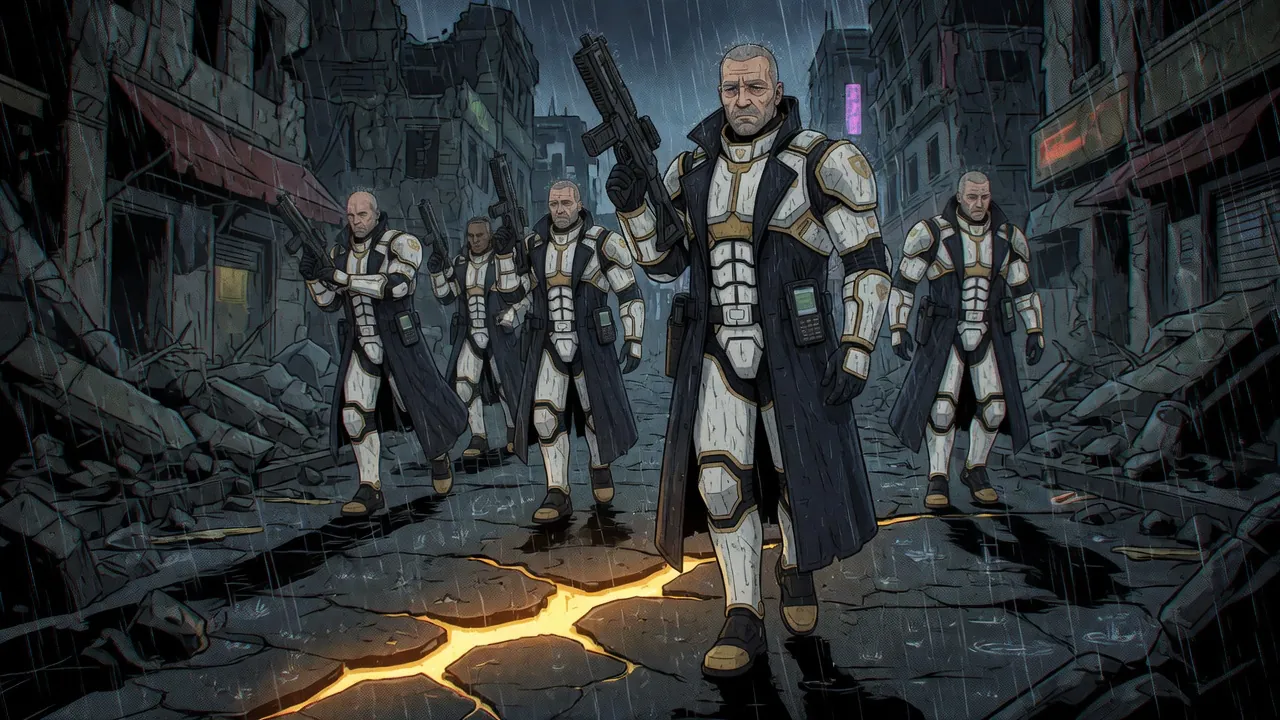
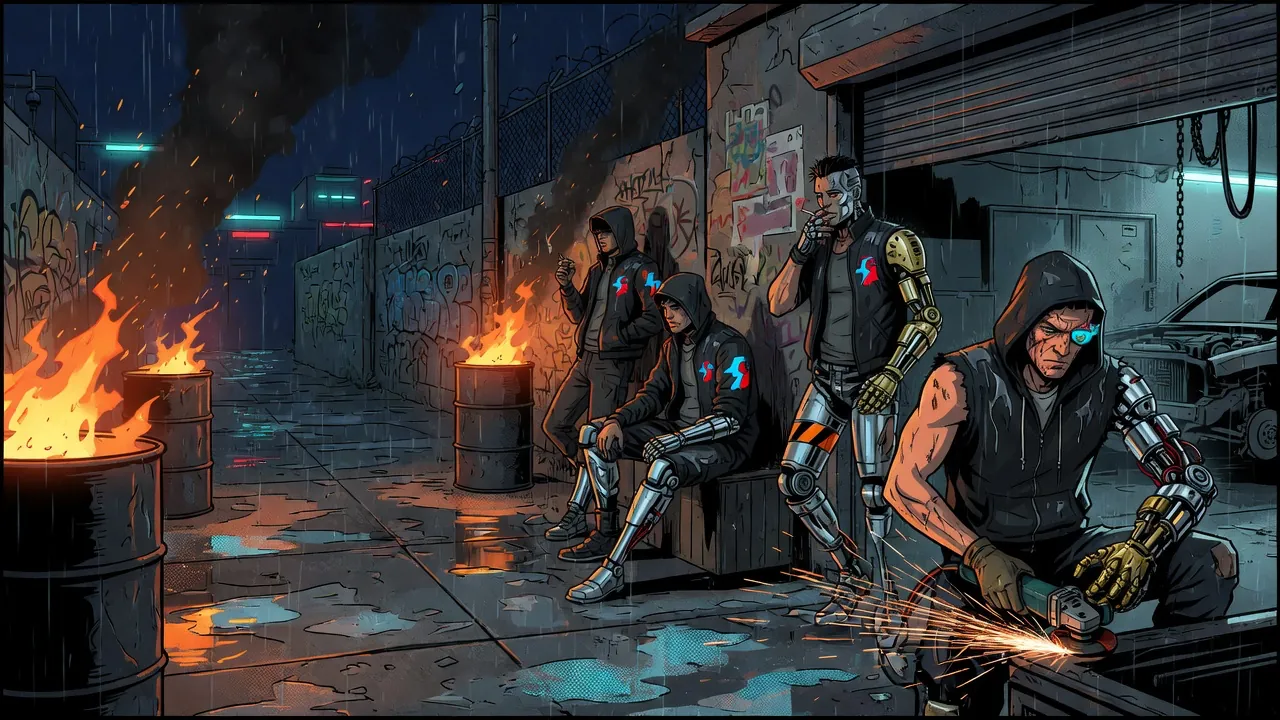
The street answers your fighting with a ladder of owners. Chrome Dogs come first, and the Wick is their ground. Meridian Security follows when the heat is higher, and Bleedthrough comes up at breach scars. The same machines turn up under each owner. See One chassis, three custodies.
Heat
Partly built Heat is simulated on the server in the Wick. A Legend's HUD does not show it yet.
Heat rises with your kills and your engagement and falls when you disengage. A Legend is meant to call the tier from a rooftop without reading the HUD, so each tier has its own colour and pattern. Heat decays, which means running away is always an answer.
Every district has a ceiling. The Wick tops out at tier 3, Overpass Fields at tier 4 and Breaker Rows at tier 5. The Wick reads its heat off its own lamp rows, and Overpass Fields reads it off the dead lamps of the expressway deck.
| Tier | What it brings | Status |
|---|---|---|
| Tier 0AMBIENT | The city is hostile at rest. | Partly built |
| Tier 1HOSTILE | The first storm wave. | Partly built |
| Tier 2LETHAL | The anti-air floor engages: units that punish a Legend who hovers. | Partly built |
| Tier 3BLACKICE | Elites are guaranteed and storms come harder. This is the Wick's ceiling. | Partly built |
| Tier 4 | A Nexus enforcer is guaranteed and the sky stays glitched. This is the ceiling of Overpass Fields. | Designed |
| Tier 5TITAN | A titan breaches at the nearest scar. Breaker Rows only. | Designed |
The residents can read the tier from the lamps faster than your HUD can tell you.
Storms
In the dev build Storms run in the Wick in the development build.
The director alternates calm stretches with storms. A storm announces itself ahead of time: the sky glitches, a sting sounds, and the spawn anchors at alley mouths, windows and rooftop edges light up before they fire. Nothing spawns in view.
A Wick storm builds in an order, and each formation is named for the tier it belongs to.
- Tier 1
HOSTILE
Ground first, then a lane, then air.
- Tier 2
LETHAL
The firing line lands first and the melee closes behind it, so the right read is to move and not trade.
- Tier 3
BLACKICE
Cable Vipers on the facade price the sky.
Heat between districts
Designed Carrying heat from one district to the next is the game's design.
Dive threat only rises. Street heat climbs with your aggression and drops when you stand down.
Running to the next district carries your heat with you, so leaving starts a chase.
Strain in a fight
In the dev build Strain runs in the movement code in the development build.
Travel is free and combat flight costs. Cruising the city never drains Strain, and safe districts cannot drain it at all. A Legend who fights from the air fills the meter by hovering, casting and taking hits, and it refunds when they land or perch.
Overstrain never drops anyone out of the sky. Boost locks, top speed decays, the aura gutters and the Legend hits for less while airborne. The street answers hovering on purpose: Stingers punish it and Vipers tether it. The designed rhythm is dive in, burst from the air, land or perch, and go again. The word names a second thing as well, the load of everything a Legend has installed. See Strain.
Downs and revives
Designed Going down and being revived are the game's design.
A Legend who falls in the street is down for a short spell. They can crawl, keep their camera and ping, and anyone can revive them with a hold. No party is needed. If nobody does, they respawn at a med-station for a small fee and lose no materials.
In the dev build Death and respawn work in the development build. A Legend who falls returns at the district's safest entry.
What the street pays
Designed Street kills pay no XP and no loot in the development build. The payouts are authored and the rooms do not hand them out yet.
A kill pays a little in creds and materials, and a streak raises the payout until the Legend falls. From heat tier 3, a reward node opens a cache that has to be channelled under fire.
Whatever the street pays goes into a satchel. If the Legend dies the satchel drops, and they can recover it once. Tier 4 adds a pinnacle contract and tier 5 the titan.
Street loot is creds, materials, rep, blueprint shards and low-tier gear. It is never a subroutine: those belong to the dive.
How legal status changes it
Designed How legal status shapes the street is the game's design.
Licensed, Ghost and Blacklisted are legal statuses, and the street treats them differently. The worse your standing with the registry, the more of Meridian Security's attention you draw.
Who you fight
Each family has its own page.
- Street machinesFive kinds of municipal and industrial kit, found under all three custodies.Partly built
- Chrome DogsChopped-in Legends and the machines they have collared. The Wick is their ground.Partly built
- Meridian SecurityThe same machines under a writ, with a job code and a scanner at the hip.Partly built
- BleedthroughMachines taken over at breach scars. Punctual, and lit by their own work lamps.Partly built
- Enforcers and titansOne named enforcer for each custody, and the titan the Seal sends after them.Designed