Build someone the registry can't file
Pick an archetype, two powersets and a travel line, and learn what each one costs you in a fight.
Where your power comes from
Default
Spliced
The city put it in you.
Powers are installed at the Splice Clinic, in public.
Alternative
Cleanskin
You refused the needle.
No weave-alloy, no Surge, nothing for the registry to scan. A gadget belt and a peak-human baseline instead. See the fork below.
Eight archetypes
On the street an archetype is called a line: a way of fighting someone else worked out first and you learned from them. Seven can be chosen in the creator. Revenant has to be earned.
In the dev build The creator runs in the development build. Only SALVO's kit runs in a fight.
-
Assault
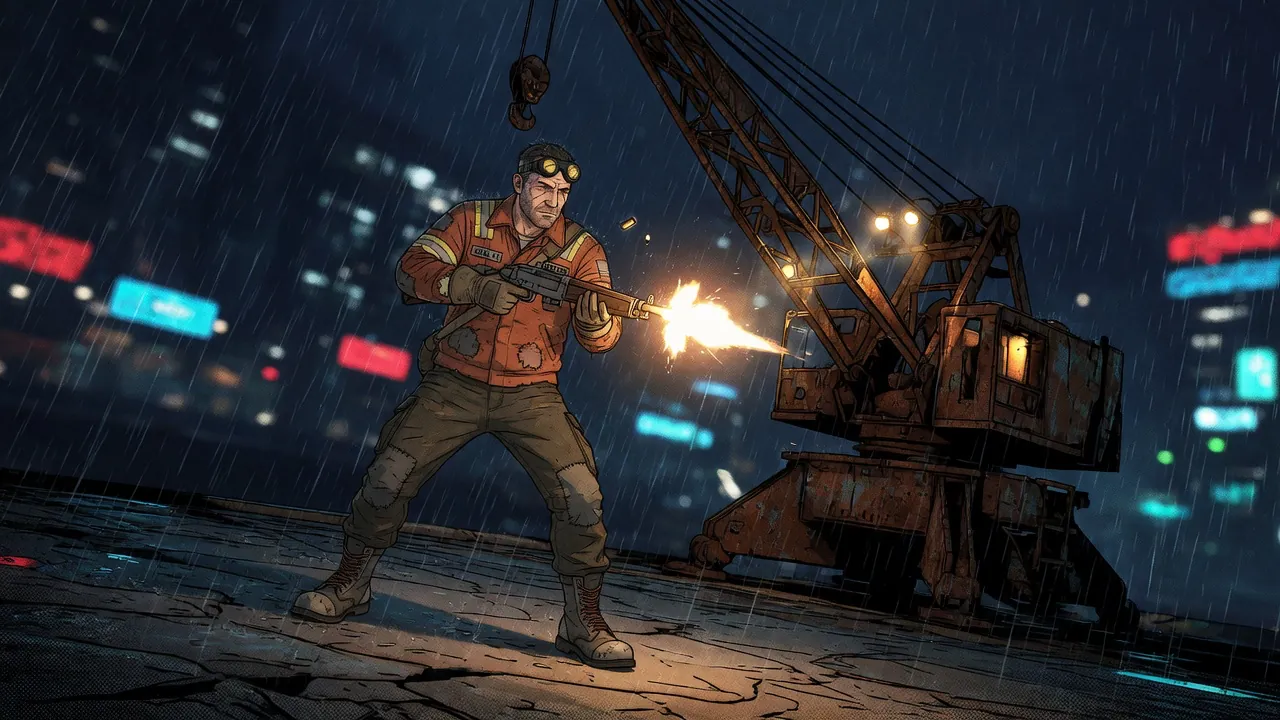
SALVO
Ordnance on tap.
-
Support
Motherboard-9
The deck that thinks back. Shields, turrets, and a network that keeps your squad alive.
-
Brawler
Rondo
Rhythm as a weapon. Every hit lands on the beat, and the beat gets faster.
-
Vanguard
Girder
Load-bearing. You are not winning the fight; you are the reason it has a shape.
-
Controller
Fermata
The mark over a note that says hold it as long as you like. The street stops where you decide it stops, and starts again when you say.
-
Infiltrator
Subito
Suddenly. Nothing, nothing, nothing, and then it has already happened.
-
Conductor
Consort
A consort is one instrument that happens to be in several places. You do not command a crew; you build one, and it goes through the door first.
-
PrestigeEarned by rite, Operator 50
Revenant
The city killed you once. It did not take.
After the archetype, the creator asks for a body (lithe, athletic or heavy), pronouns, an accent colour and a power look.
Eight ways to move, and what each costs
Every tree costs the same 22 travel points, and a first node opens at Operator 10 (Operator is your level). What sets them apart is what each one costs you in a fight.
Partly built Six lines run in the development build. Jury-Rig's gadgets are not built, and Fluxboard is in the workshop.
-
Skybreak
The Lattice never revoked the sky.
The cost. The most punished line in a fight. You take Strain while hovering in combat, you are the biggest silhouette on the street, and Meridian no-fly domes shut you out.
-
Redline
Your legs subscribe to the conveyor.
The cost. You need runway. Any hit drops you back to a walk, and you can't cross gaps.
-
Ghostware
You decline the distance instead of crossing it.
The cost. Bursts, never a cruise. Every blink leaves a shimmer, the loudest tell in the game.
-
Graviton
Crane permissions. The oldest maintenance right in the city.
The cost. Anchors or nothing.
-
Tiderunner
The only line that is faster below the surface than above it.
The cost. Water only.
-
Freerunner
No weave, no wings, no excuses.
The cost. The slowest top speed of the eight. It is also the only line that is never clamped in a fight.
-
Jury-Rig
You engineered around the needle.
The cost. Borrows every verb, masters none. It jams, and it runs dry.
-
Fluxboard
Somebody welded handles onto a freight plate.
The cost. It cannot climb.
Fifteen powersets
In Catena they call powers leaked permissions. Each set has three abilities and one passive.
- Heavy LiftThe city was poured for people who weigh what people weigh.
- QuicksilverEveryone else is waiting on a queue you were moved to the front of.
- SkywritAltitude is a position, and you are the only one holding it.
- Arc LanternThe grid never stopped paying out.
- Long WritGun before ware.
- KilnworkThe Deepworks still runs hot, and you are one of its vents.
- ColdsnapYou are not stopping them.
- RootkitEveryone else inherited a superpower.
- HardlightYou put a wall where there wasn't one, and the argument ends.
- GraftworkThe city keeps taking pieces off you.
- NullskinThe registry cannot file what it cannot see.
- DownwellDown is a setting, and you are the one holding the dial.
- GreytideYou do not carry a weapon.
- Signal ChoirYou do not shout.
- IronweaveYou are the reason the rest of them get to be clever.
Or no powers at all
The scanners at every checkpoint read weave-alloy. A Cleanskin gives them nothing to read.
The design gives a Cleanskin a gadget belt, a peak-human body and Clutch, which buys Focus (bullet-time) and one Second Wind (survive a killing blow, once). Clutch, Focus and Second Wind are designed and not built yet. A Cleanskin can still take powersets, carried on hardware instead of in the body.
Cleanskins keep the gear and skill lines (Freerunner, Jury-Rig, and Fluxboard, which is still in the workshop) and get Freerunner's first node free.
At Operator 30 the road is designed to fork