City life

One, four, nine, and the rest is rent. This is how Catena registers, feeds, buries and judges the people who live in it.

Records and forms

Every ordinary thing a person does in Catena reaches the city as a filing: a birth, a household, a death. The filing is the whole ceremony. There is no clergy to bless it and no court to argue it, only a counter, a form number, and a clerk who is not unkind and is not going to look up.

Civil records are kept by the Municipal Register, which runs out of the Constabulary's building with clerks who are not Meridian and are paid like it. Its forms are numbered in single digits, which is the quickest way to tell it from the Coil. The Municipals count to nine. Meridian counts to four thousand.

The street keeps the three forms in a saying: one, four, nine, and the rest is rent. One is a birth, four is a household, nine is a death, and the rest of a life is paying the Habitation Trust to be somewhere while it happens.

FORM 1 · BIRTH

Fee: as scheduled

Household alloy: Y / N / relation

The Municipal Register counter The alloy box has been on the form since the Turn. Children born before it have a form without.

FORM 4 · HOUSEHOLD DECLARATION

Two or more adults. One address.

Signatures: 2. Witness: a third adult with an address.

Status: declared

The Municipal Register counter This is the marriage. People do not say married. They say declared.

FORM 9 · CESSATION

Clock: six days, unless alloy was present

Status: pending

The Municipal Register counter Where alloy was present the file goes to the Tribunal, and pending has no end date.

Households, names and the old

A household is four to seven people at one address. Two of them are related and the rest are the reason the rent works. The people you live with are the address, used like a noun: the whole address is down with it. A person with no address is not homeless. The city's word is unplaced, which is a housing status and, in a Meridian mouth, something else.

You can date an adult by their name to within a year. Children born in the first years of the Kindling were named after whoever had done the thing in the reel that season, so one classroom in the Wick has four children with the same street name and the teacher numbers them by desk. After the Turn nobody does it. A child born since has a flat, short name, chosen on purpose, and the parents will tell you it just sounded nice.

The old are mostly warm and never spliced: Loom-era hands with weave-alloy worn into joints that were already worn. They got a decade of lifting the stove and no parades. They do not fall, they get up, and both facts unnerve their grandchildren. Care is a union rota or it is a chit chair, a canteen table where an old person can sit all afternoon on one meal credit, because a full room looks like a busy shop from the street.

Put me on Tuesdays. I'm no good at sitting and I'm worse at being sat with.

A Yards elder, at the top of the rota sheet

When somebody goes warm

When somebody in a household goes warm, four administrative facts reach the family in one season.

The occupant schedule is wrong. The address's Form 4 now lists someone who is not what it says, and correcting it is a filing.

The rent is repriced. The Habitation Trust does it at renewal, without comment, in a letter about maintenance.

The cover develops an exclusion. Bastion Mutual's household policy picks up a clause that nobody can find the sentence for.

The Bell rings. The Clinic bell sounds once, the whole district looks up, and the family has ten seconds to decide whether it is proud in public. See Workshop Block.

Everyone keeps congratulating me. I've got a letter about maintenance in my coat.

A mother at the Cradle Bench

Death

A death is a Form 9 and six days, unless alloy was present. A death with alloy in it is removed to the Licensing Tribunal like any other alloy matter, and a removed Form 9 has no clock. Its status is pending, and pending has no end date, because nobody ever wrote one. The body waits in a Tourniquet recovery bay, running up an observation fee by the day.

You cannot dig in Catena. The city grew on the works, and under two metres of almost anywhere there is somebody's conduit or the works itself. The union has its own arrangements, kept in the book. Everyone else has three choices. The Longshore Ferry's second run on the last day of the month takes no fares, goes out past the Stilts and stops short of the reef, and nobody calls it a funeral run or waves at it. The Offcut crews in Rustfield will do it at night for a fee. Or the Municipals hold the body until the file closes, and then there is a shelf.

There is no officiant, so nobody says words over anybody. What people do, in every district and without ever having agreed on it, is read the entry out. The union reads the book. The backs print the name in the Tuesday list. A family with neither reads the Form 9 aloud off the carbon, at the address, with the fee line still on it.

Somebody sits with the body. Weave-alloy and hardware from the recently dead move quickly into the chop-shop trade between a death and a filing, so someone stays in the room. Old people sit, mostly, because they can. Nobody explains this to a visitor. They make a chair available and look at you until you take it.

Recovery observation continues while the file is open. The rate is on the reverse.

A med-station counter clerk

Name, date, and what she was doing. That's the record. Sit down, all of you.

Big Ferro, closing an entry

Two hours. Don't read anything, don't answer the door, don't let anybody be helpful at you.

An aunt in Breaker Rows, handing over the chair

Growing up

Children play Splice or Snitch. One child is the scanner and the rest try to cross a chalk line without being flagged. Even the Coil's apron gets the game, where the kids are moved on politely. They also hold Surge pose-offs, miming the Sync ranks from D to S for bragging rights, with no augments required.

The Legend cards of the Kindling have become stickers cut from clip footage, an accent colour and an onomatopoeia doing the job a stat line used to do. Children learn the Kindling the way they learn the tide: from the wall, from the backs, and from an adult who stops talking mid-sentence. See the Kindling.

There is no school system. There are several unconnected answers to what a child does all day, and they sort children by class more than anything else in the city. In the Wick the school has no name, runs by heat tier and teaches the lamp rows before it teaches letters.

SCHOOL RUNS AT TIER 0 AND 1. AT TIER 2 GO HOME BY THE INSIDE ROUTE. AT TIER 3 DO NOT COME.

The Wick, school gate

Food

Most of what Catena eats is vat protein from Tallyman in one of a dozen flavour packets. The premium tin costs four times as much and is the same vat base with a different packet.

Cable broth is a savoury broth heated over repurposed conduit, a Yards speciality served from carts that double as union meeting places. It is broth and never noodles. Sparkfry is skewered protein fried at illegal conduit-tap stalls, cheap, slightly dangerous to make, and loved. Chit cake is a dense ration bread, eaten on Kindling Night and almost never otherwise.

Service at the broth cart on the Junction's well rim is two words long, and its owner will not repeat a rumour for a second customer. Ma Torro's in the Yards has been the locals' meeting room for nineteen years. The things the city runs short of are real food, housing near the Coil, clean medical care without a licence, and information anyone actually trusts.

EAT FIRST. TRADE AFTER. THAT'S THE WHOLE RULE AND IT ISN'T A FACTION.

The Sunken Mile, Deck Kitchen

News and the signal

Catena gets its news from Cascade, the backs, Board Wire and Nyx Static.

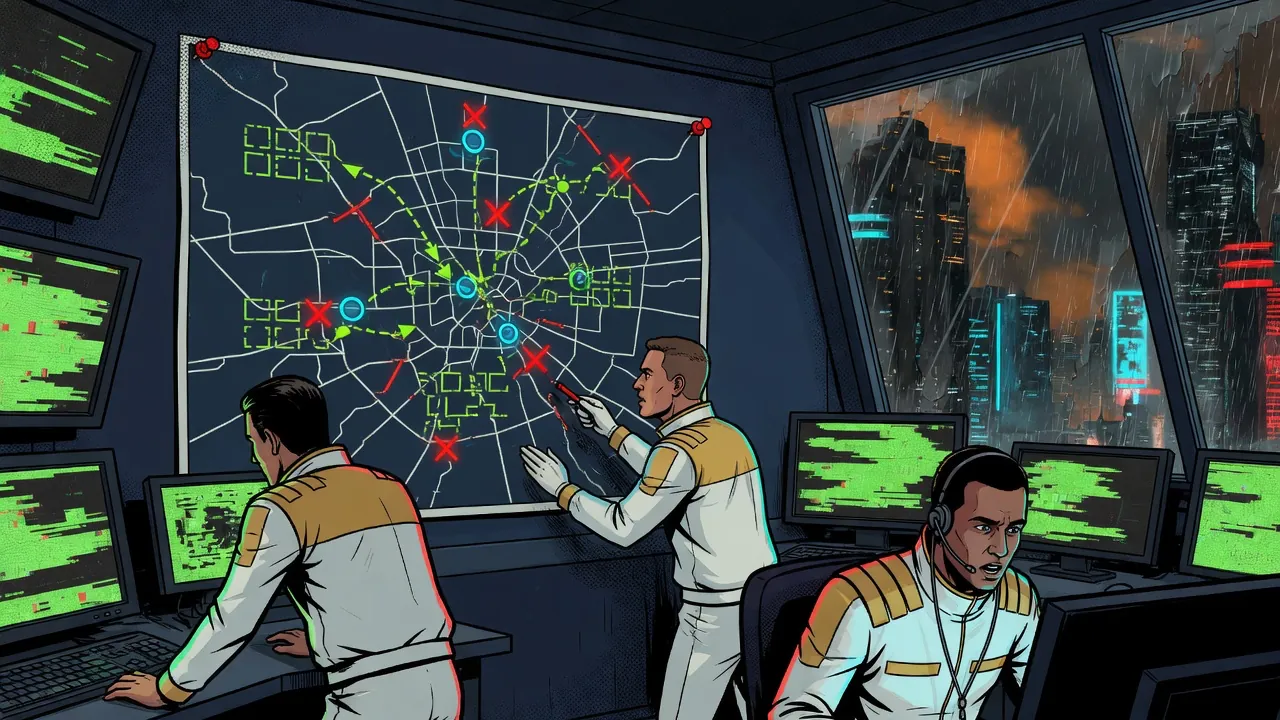
Meridian technicians track a signal across a wall map of the city, their screens full of green static.
Meridian technicians chase her signal.

Cascade Media

Cascade is the news everyone means when they say the news. It coined cascade failure, and it keeps a standing, informal kill-order on any segment that gets near a fact the corporation would rather not air. Its chief has not needed a direct order from the Coil in twelve years.

Cascade prints the Daysheet, a free single sheet at every stall and platform: transit, tide, market closes, weather and three ad reads. On Seal Day it carries one more paragraph.

Services normal.

Tide at four.

Weather holding.

The foot of the Daysheet, on Seal Day

The backs

Cascade prints the Daysheet on one side only, so the back is free paper in every district, every morning. Backprinting grew into a trade. Presses in Lowline basements and Market Row's shade quarter run a second impression on yesterday's sheet, and the result is called a back.

A back carries the week's lamp tiers by street, a list of names, the prices Cascade will not print, and an argument. The list is of who went out and has not come back, and it is called the Tuesday list. The city's real newspaper is a missing-persons list, and the four walls are the same document in tape instead of ink.

Yesterday's weather on the front. Today's on the back. Don't be seen choosing.

A backprinter

Board Wire

Board Wire is Meridian's channel for investors and the board: dry, numbers first, no presenters. It was made for Licensed climbers. Its real audience now is the Relay cell of the Undercurrent, Scrapline's stewards and about two hundred backprinters, because it is the only outlet in Catena that publishes figures. That makes it the most trusted news source in the city.

Capex on the east yard's down to nothing. That's not a budget, that's a closing date.

A union steward, reading the Wire

The signal

Nyx Static's pirate broadcast does not do news. It opens with half a second of carrier tone, the same half-second every time, and Lowline's producers all sample it. She does not take calls, and she describes what she cannot see with total accuracy.

Static-punk grew out of the gaps in her broadcast, made on stolen bandwidth. Coil-pop is its licensed opposite, with Halcyon himself doing the odd jingle between ad reads. Between-hours shows fill her dead air, and two rules hold: the carrier tone ends everything, and nobody broadcasts into the Quiet.

Rank & File and accent spotting

Rank & File is Cascade's weekly countdown of the best S-rank Surge clips.

Accent spotting is the amateur game of working out who a masked Legend is from nothing but their accent colour and kill signature. A clip of the Legend with the cold-cyan accent and the three-beat finisher spreads faster than any name could.

Belief

Meridian has never banned a thing it could tax, and it has not had to ban religion. Catena has none, and has had none long enough that the vocabulary went too. A five-year-old in Catena does not know a word for prayer.

Things here answer to metal, to proximity and to what you have been seen to do, and prayer makes no difference. Everybody in Catena has watched something enormous and indifferent decide about a person on the strength of a workplace exposure.

What the city kept is the observances without the reasons. Divers keep to them as practices: they count the notes of the Chorus, knock the plate of the Hoarding on the way past its back, and let the first Scrap Rat go. Tenants in the Wick knock the ceiling once before they sleep and say it is for the pipes. The one religious word in daily use belongs to divers, who call an ICE unit that keeps its dead in service the Chaplain.

The rites nobody wrote
RiteWhat people do
The QuietSeal Day, once a year, for one minute: every broadcast in Catena goes dark. No law requires it and nobody has broken it.
The BellOne ring for each completed First Splice at Workshop Block. Strangers in the street look up.
The BookThe union's death-book, opened on the Ledger House floor and read aloud. Everybody stops talking.
The WallsFour districts keep four walls of notes, chalk and candles for people at the wrong depth. None has been cleared in twelve years.
The Deck KitchenAt the Deck Kitchen on the Sunken Mile you eat before you trade. People comply by their second visit.

Law

Two forces police Catena, and they divide on one thing: alloy. The Constabulary, the Municipals, handles everything that does not involve it. The instant a Clarity scanner chirps, jurisdiction passes to Meridian Security. Civilians prefer to call the Municipals first, because a civil matter calls down no alloy paperwork.

A Municipals week is half property and a quarter disputes inside one address, and the rest is errands. In no column at all, and the biggest, are missing persons, which are not theirs. A diver who does not come up is a charter matter, which is a Meridian matter, which is a form. The families come to the Municipals anyway, because it is the only counter in the city that will take a statement from someone crying.

Any matter touching alloy discharge is removed from the ordinary lists to the Licensing Tribunal. Removal cannot be opposed, and the Tribunal's calendar is measured in months.

Below the Tribunal there is one court, and it is not called a court. The Small Docket sits four days a week in what was a Loom-era pay office: one magistrate, no jury, a list read at 09:00, and about forty matters a day. A tenancy dispute takes eleven minutes, and the times it goes wrong are the times a person needed forty.

Every landlord's agent knows the trick. If you are going to lose at the Small Docket, say a Legend was present. It does not have to be true, only arguable, and the matter goes upstairs, where it will not be heard this year and the tenant, who needed a decision this month, moves out. The counter-craft is to keep alloy out of it, and everyone in the Fringe knows that too.

Three other venues are not courts at all. The Counting House arbitrates commercial disputes above a certain size, and is fast, expensive and reliable. The Ledger House floor votes on union matters with the book open, and nobody has ever wanted an appeal. The Warrens settle a stall dispute under old dock-labour custom in about ninety seconds, after which the loser is expected to be seen buying from the winner. Catena has never had a jury, and in twelve years of complaint about the Tribunal nobody has proposed one.
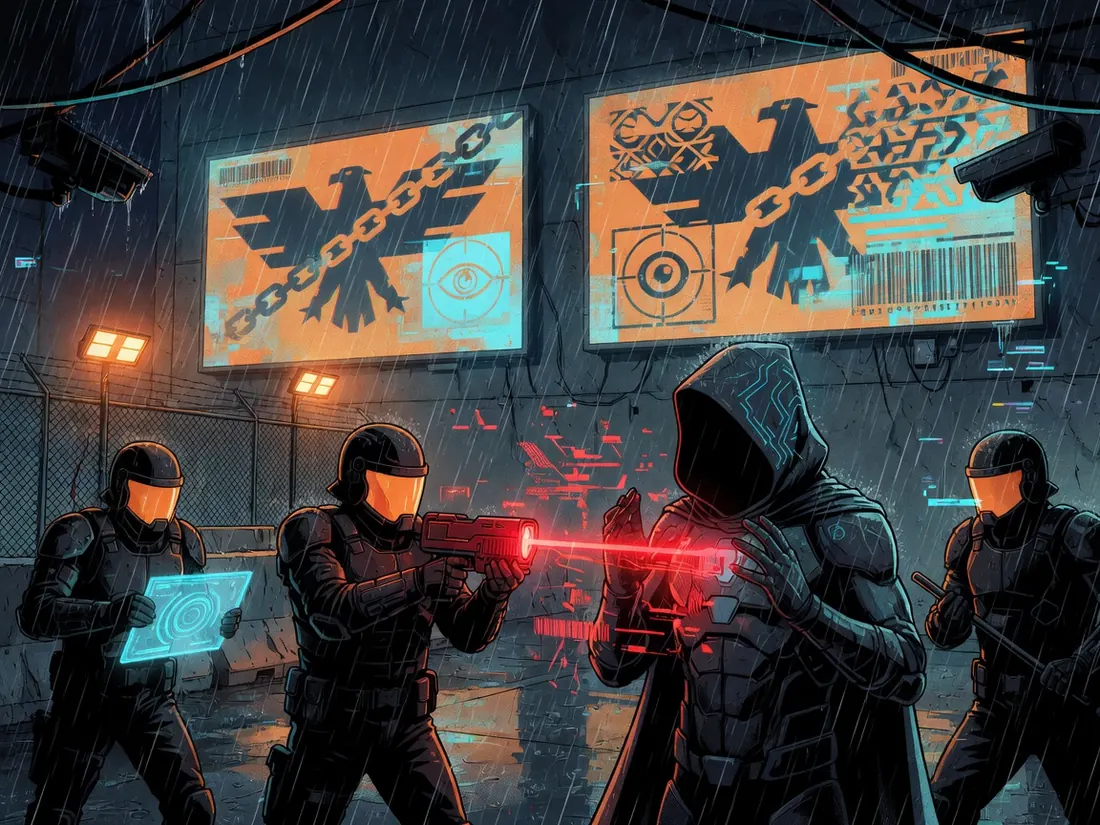
Masked officers with orange visors scan a hooded figure at a checkpoint under posters of a chained eagle.

Every name on that wall at the Junction is a case I'm not allowed to open. I know the drawer it's in.

A Municipals sergeant

Counsel says discharge. Counsel says it every Thursday. Is there a scanner log, or is there a Thursday?

A magistrate on the Small Docket

CONSTABULARY. Alloy incidents transfer automatically.

Everything else is ours and we would rather it stayed that way.

The Municipals' post beside a checkpoint The second line is in pen.

You are not being detained. Your classification is being corrected. You may leave when the correction is entered.

The first line of a reclassification notice

Hearings run to the hour posted. The hour posted is not the hour on your summons.

The Tribunal waiting-room board

The desk trade

Catena has no crime families and no protection racket a visitor would recognise. Organised crime needs a service the state won't provide, and here a corporation provides everything, badly, at a price. So crime grew into the paperwork, and the street calls it the desk trade. It is clerical.

The trade begins in the Renewal Line at the Coil. Line-holders stand in the queue for a fee. Expediters sell an appointment: they know which windows run fast, which clerk is off, and which four-digit code sends a file to a desk that answers in a week instead of a quarter. At the top are people who know a clerk.

A forged licence is worthless, because the registry never forgets and every scanner in the city talks to it. What sells is a real filing with the wrong facts in it. You buy ten seconds of a clerk not looking while a genuine one is created, and after that it is true.

Protection is sold against a filing, and not against violence. Pay monthly and nobody reports the unlicensed splice work in your back room. The collectors carry clipboards and say premium.

The debt that shapes the most lives is the splice debt. Doc Splice's ceremony costs money, and Fast-Splice costs less. Meridian does not lend to the unlicensed, so somebody else does: a share note fronts the install against a share of a year's salvage, on verbal terms enforced socially. The lenders are ex-installers, small brokers, a fence, the odd respectable stallholder with savings.

I don't move files. I move where they land, and the difference is about eleven weeks.

An expediter in the Renewal Line

Money and rent

Creds are the money everyone actually spends: wages, rent, the market. Food terminals run on meal credit, whose denominations are the old ration chit's, unchanged. See currencies for the game's money.

Nearly every roof in Catena belongs to the Habitation Trust, and the Trust belongs to Meridian. Everyone in Catena rents from Meridian. Cheap things are Fringe rent in the affordable tier, which is code for undermaintained, and vat food. Dear things are anything within sight of the Coil, real food, a proper Clinic ceremony, and insurance near a scar.

A tenant's day touches several of these companies before lunch.

Heat, water and light come out of the works, and no invoice has been issued for any of them since 2081. Meridian bills for distribution and maintenance instead. Everybody has been waiting twelve years for the other bill.

Ten companies, one line each
CompanyWhat it does in a day
SutureImplants. Its failed-certification seconds leak into the chop shops, and its Fast-Splice franchises install for less than the Clinic.
Clarity SystemsThe scanners at every checkpoint, and the closest thing Catena has to a brand mark everyone knows. See Checkpoints.
Bastion MutualInsurance. A clause called the Act of Seal excludes any loss near a breach scar.
Tourniquet HealthMed-stations, each independently owned and operated, with a per-use fee for a revival.
TallymanFood. Vat protein in a dozen flavour packets, and a premium tin that is the same base with a different packet. See Food.
Habitation TrustHousing, and the risk premium for anyone whose classification is wrong.
Deadbolt MunitionsArms. It supplies Meridian Security's whole uniform and, off the manifest, the Chrome Dogs as well.
Cascade MediaThe news. It coined cascade failure. See News and the signal.
The Counting HouseClearing. A banking guild older than the registry, with a faceless board. See Market Row.
Deepline SalvageFences salvage, a good share of it from charters.

Water's still on.

Said over a stall

Water's still on.

The answer, in the same words

ONE MEAL CREDIT. NOT TRANSFERABLE.

A Tallyman meal terminal The denominations are the old chit's, unchanged since 2082.

YOUR HOME IS MANAGED

A Habitation Trust doorplate, screwed on over the old number Under it, smaller, the Trust. Under that, smaller again, Meridian.

Your tenancy carries a risk premium reflecting your current classification. This is not an eviction notice and no eviction is contemplated at this time.

A Habitation Trust risk-premium letter

The calendar

The city's day, month and year
WhenWhat happens
Every day, 04:00The seed rolls over and the flip-board at the Junction calls it. A handful of insomniacs and shift-enders always watch.
Every day, 05:00 and 17:00In the Yards the chains go out at five and the whistle sounds at 17:00. The book comes out after.
Every day, 05:40Shift change at the Coil, unlit and silent, through the service gates.
Every day, 08:00The renewal windows open. The queue is already long at 07:20.
Every night, 01:00 to 05:00The loud hours in Lowline.
Once a monthDead-drop night in Lowline, when the Undercurrent's faithful gather to receive whatever the signal carries. On the last day of the month the Longshore Ferry's second run takes no fares.
Once a yearKindling Night. The murals are touched up, children get real food for one night, and the chit cake is gone by sundown.
Seal DayOnce a year, for one minute, every broadcast in Catena goes dark. See the Quiet.
The AuditScrapline's yearly charter renewal, run by Ledger's office. It has become the date the whole city dreads. See the Audit.
First Splice anniversariesA card and a bad joke, always about the needle.

The four walls

Four districts keep four walls for the people who did not come back, and nobody has ever proposed clearing any of them. Each keeps its dead differently. The Lost Wall at the Junction is notes, people talking to someone. The Tally Wall at Westgate is names and dates, a count that can still come out right. The Candle Wall in Breaker Rows is numbers, because the Rows knew every door and will not say the names aloud. The Deepworks Cable Head in the Yards has no writing on it at all, and that is the one that frightens people.

The Municipals have a view of them. Every name on the walls is a case they are not allowed to open, so the four walls are the Municipals' unfiled caseload, made visible by the public, in tape.

Third time I've written this out. Paper goes soft. You'd have laughed at that.

The Lost Wall, the Junction

206 chalked.

90 rubbed out on return.

The Tally Wall, Westgate The custom is that you rub out your own name.

WE KNOW ALL THE NUMBERS. THAT'S WHY WE USE THEM.

The Candle Wall, Breaker Rows


The Deepworks Cable Head, the Yards Not one mark in twelve years, in a district that writes everything down.

The murals

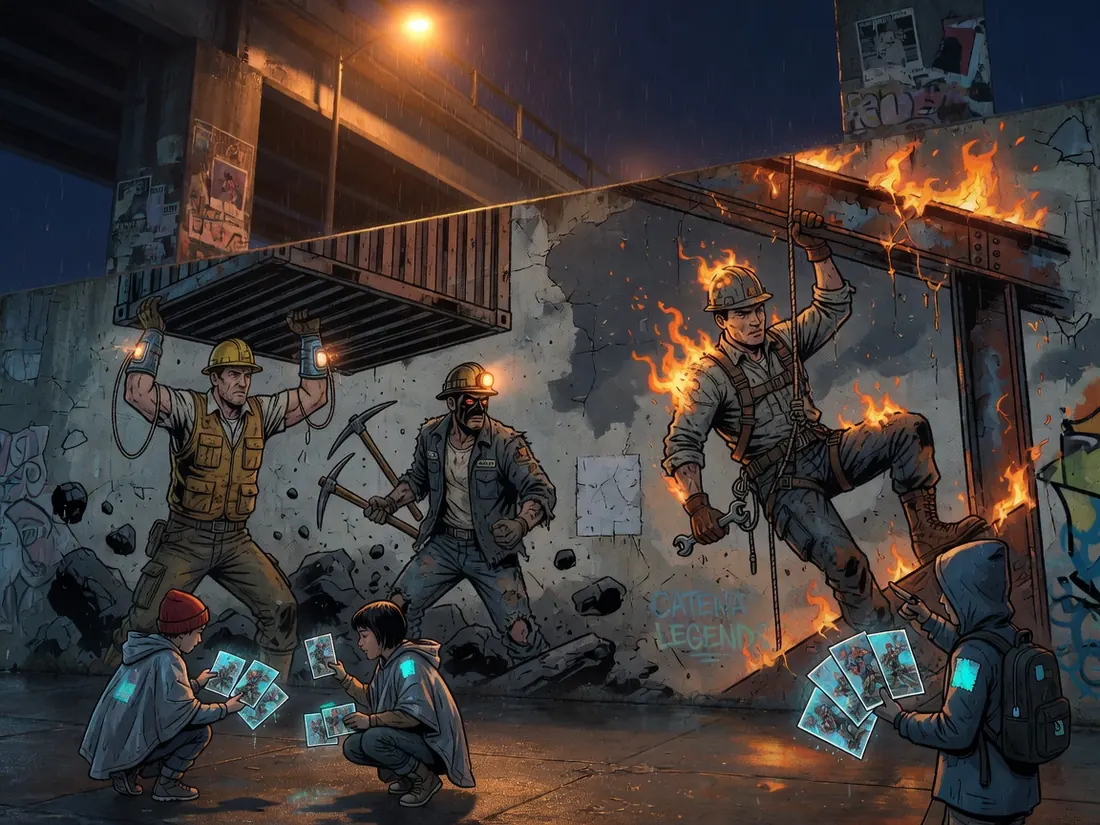
The murals are the visible memory of the Kindling, each of them a thank-you note for a specific job. They stop three blocks out from the Coil. They survive best in the Fringe, where Meridian would rather not send a scrub crew somewhere its security does not patrol in force. Where scrub crews do come, they leave a grey rectangle, and the grey is almost right.

Mural wardens are citizens of no faction who repaint within forty-eight hours of a scrubbing. What they lose over the years is colour and not the picture: the mixes went out of production, and the swatch cards get copied from copies. Bleedthrough has never touched a mural. See the host law.

Children trade glowing Legend cards in the rain beneath an overpass mural of three workers, one of them on fire and still climbing.
Five murals
MuralWhereWhat it shows
The Eight HandsThe Gantry Line underpass, The YardsEight hands, the faces left as bare concrete.
First TakeoffMrs. Amperage's Underpass, The WickA Kindling Legend leaving a rooftop.
The Smiling ManUnder the Overpass Stack, Overpass FieldsHalcyon from before he took the licence, painted by request.
Chorus LineThe Sluice Fall retaining wall, LowlineDancers with accent-colour trails.
The Ration QueueA service alley beside Scar Plaza, Market RowThe only mural inside the safe core.

Nothing that never worked has ever been taken. That's why the murals are still up.

Mrs. Amperage

Leave the edge showing. If we make it perfect, in ten years it'll have always been perfect.

A mural warden

How each district feels about Legends

Feeling by district
DistrictHow it feels about Legends
The CoilLegends come to be counted, in a queue that is already long at 07:20.
Market RowA broker quotes a Legend as a spread.
The JunctionPatch finds new Legends before the registry does.
Workshop BlockThe street looks up every time the Bell rings.
The YardsLegends are members, and their names go in the book.
LowlineEverybody the registry made expensive lives here, and the signal is theirs.
The Wick and the rest of the FringeResidents shutter up for the fight, watch it from the windows, and bring the downed inside afterwards.
The DeadbandNobody lives there.

...Did you see that?

What you say, to nobody, twice, when it goes right

On every street

Somebody is always eating: cable broth, sparkfry, chit cake.

Kids are playing Splice or Snitch, even on the Coil's apron, where they are moved on politely.

Somebody is repainting something.

There is a queue, and every queue has its own customs.

After any fight, people play at accent spotting.

Somebody is listening to Nyx Static and pretending not to, and the Coil's canteen is where they pretend hardest.

Somebody is waiting for a diver to come back up.

What Catena does not have

These are the things a visitor expects to find, and what stands in their place.

Absences
There is noWhat there is instead
ChurchFour rites that nobody wrote, and a wall. See Belief.
JuryNothing. The company courts never had one.
School systemA union card, a shopfront with one adult and a register, and the Wick's lamp rows. See Growing up.
CemeteryA ferry run, a night burn, a shelf, and the union's book. The works lies under everywhere, so there is nowhere to dig.
OrphanageThe address, the local and the Commons. Children are absorbed.
PensionA union rota, or a chit chair.
Newspaper of recordCascade, Board Wire, the backs and the pirate signal. See News and the signal.
Crime familyThe desk trade.
WeddingA counter, a witness and a stamp.